Wednesday, October 17, 2012

Perspectives

Cityscape one way


Or another


- Posted using BlogPress from my iPhone.

Tuesday, September 18, 2012

World Press Photo 2012

 
People living in a city are very fortunate because the city offers multiple benefits in retrospect to economy, food, freedom of speech, etc. Furthermore, some people are ignorant of the contemporary issues and daily life of other nations around the world. Some of these important matters are not even confronted by television newscasters because they are too “graphic to show” or too “taboo”. Fortunately, I am proud to know that a non-profit organization promoting photojournalism has established an annual exhibit in Montreal, the World Press Photo.  
This fall at the Bonsecours Market, the exhibition highlights prizewinning photographs of diverse subjects from photographers all over the world. These photographs offer more insight on matters that are poorly discussed. This year’s photographs illustrate the horrible aftermaths brought by the earthquake and the tsunami that struck Japan last year. There are also a multitude of snapshots from the student strikes that occurred earlier this year in Montreal. Of course, other controversial subjects are presented through photographs in the exhibition: some of them include animal cruelty, sports, child brides, bombings in Kabul and the 2012 mass protest in Egypt against the president Hosni Mubarak.

In conclusion, the World Press Photo exhibit is a news broadcast in stills that will definitely be an eye-opener for many.

For more information: http://www.worldpressphoto.org

Chill and don't freak out.

Every action has an equal and opposite reaction. So when cities get huge, it is not only the land that changes, but also the mind of its inhabitants.

Photo: Garry McLeod; Alamy; Yva Momatiuk & John Eastcott/Getty
The article I'm introducing is called "Apocalypse Not: Here’s Why You Shouldn’t Worry About End Times" by Matt Ridley, featured in Wired Magazine. The topic of the article is how society has predicted its end in numerous and distinct ways, through Chemicals, Pollution, Disease and Overpopulation. What needs to be noted is that in most cases, none of the predicted events (No more oil and gas by 1970) occurred or came close. 

I believe the reason that such events won't happen is that we, humans, underestimate ourselves. For example, take Steven King's The Stand, in which a super flu wipes out 99.4% of the world (it's always 99%). Mind you, the novel was originally written in 1978, when diseases such as AIDS were surfacing, but thanks to safe(r) practices, diseases are having a harder and harder time to spread with water filtration or antibacterial wipes, and science tis figuring out how to fight diseases.

There is also gas shortage. To say it simply: innovation. Technology is improving to not only make cars or devices more fuel efficient, but also to find new sources of energy. We are making cars that can run on gas AND electricity and I dream of a world when Cars will not need gas.

To read the article, follow the link below or buy the magazine in stores. (In this month's edition, there's also an article on the internet phenomena of cats.)

.http://www.wired.com/wiredscience/2012/08/ff_apocalypsenot/all/

A Natural Oasis in the Heart of Montreal


Montreal is one of the many active and cacophonous cities around the world. However, a place of escape from that busy life lies at the heart of the city and that is the Botanical Garden.  Seasonally, the Botanical Garden is filled with breathtaking gardens, ranging from a native to a Chinese theme.

Every fall, the Chinese garden highlights its captivating event, which is the Magic of Lanterns.  This latter offers a wonderful sight of colourful lanterns depicting multiple stories from ancient historical facts of China.  

Just a few walks away, the Alpine garden provides rocky paths and a beautiful waterfall for Alpine enthusiasts to enjoy.  

Further ahead, the native garden evokes the environmental lifestyle of the eleven First Nations of Quebec: replicas of the remnants of ancient camps contribute to the old native ambiance.


Finally, it would be an excellent idea to end the tour with the Japanese garden. People can walk through it with a feeling of serene tranquility. Furthermore, people can expect to be transported to a part of Japan’s rural area, with its fish pond and its traditional Japanese house. 

 All in all, the Botanical garden is a natural oasis for those who wish to be “one with nature” in four different types of environment that are surprisingly accessible inside a city.       


Wednesday, September 5, 2012

The World in which we Live

Welcome to Fall 2012.


Here are some of the current concerns shared by the class:

political instability
the environment/pollution
Pauline Marois
infrastructure, in particular roads and bridges...
schools and classrooms: education
opportunity
our economy
our hockey team
arts and culture
public transportation
language conflicts
and more.

Wednesday, December 7, 2011

“Tis the season”

As the holiday approach, stress levels arise and Montrealers don’t know how cope with all of this. In addition to the holiday stress, construction around the city is unbearable. Blocked streets and detour route commuters around the city, although these repairs need to be completed, taking a longer way to your destination is frustrating. For people taking their car into the city finding free parking or a reasonably priced parking meter is nearly impossible. In addition during the winter seasons there is a snow removal hour which Montreals need to worry about. All in all Montreal is a very festive city around the holidays however does come with a price with heavy construction and no parking.

Victor Mancini

Monday, December 5, 2011

Montreal makes NYT list of "hip" cities | Daily Brew - Yahoo! News

Montreal makes NYT list of "hip" cities | Daily Brew - Yahoo! News

The Underground City and Recycling


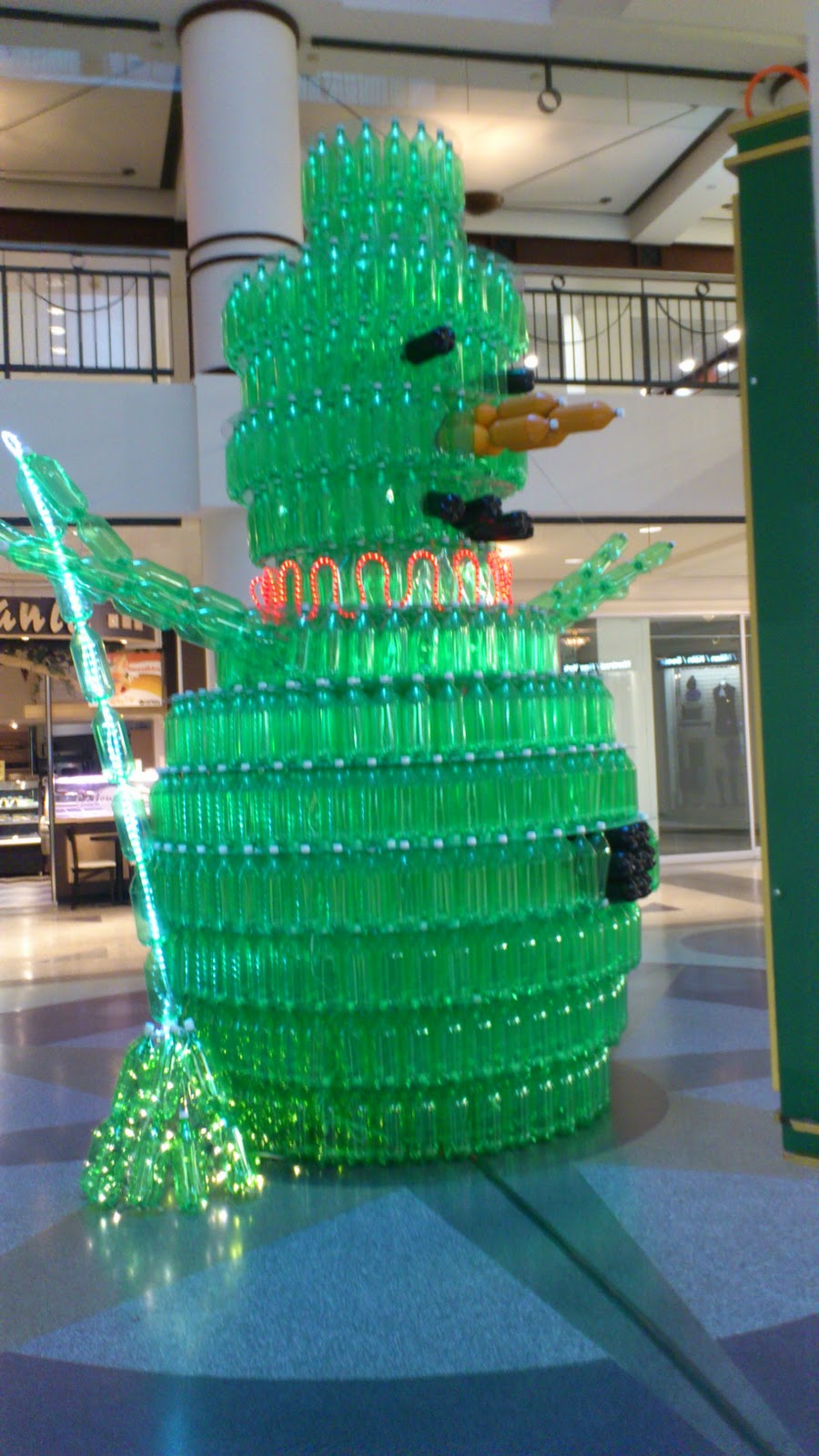
The underground city of Montreal is used by many people who are commuting to, from and through various places. This display of art  is made of re-used carton boxes and recyled paper, and is located in the Eaton Center mall, right by the St. Catherine Street exit. Since the Eaton Centre is one of the most popular underground malls in Canada, it can be used as a platform to convey global and social messages about the environment. Materials, such as water bottles, cardboard, and recycled paper are collected and made into beautiful art that is put on display for millions to see.

The recycled art is seen by many people who shop, or who simply use the exit to get to the metro. This snowman is made of green, orange, and brown re-used bottles and is located in Les Cours Mont-Royal, right by Peel Metro. In addition, this kind of recycled art is put up throughout other connecting malls, such as Les Cours Mont-Royal.

This tree is made of recycled bottles and is in Les Cours Mont-Royal:


 Text and photos by Sabrina Principe

Sunday, December 4, 2011

Personality

Climate has a strong correlation with the mood of people, their social life and their state of mind. We aren't favored with a mild weather in Montreal, cold and long winters are a struggle for some and we can see it in the change of people's lifestyle during those months of frost. Who stays outside in the winter? People don't do it unless they have to. How long do they stay, how often do they go out for a breath of fresh air, how often do they go on social meeting? The cold cuts people's contact with the outside world and shows the dark side of our city. The unsocial coldness of Montreal is reviled.

Who's Occupying?


In the last few months, "Occupy Montreal" is being a subject of numerous discussions and debates and even though, it's a bit of a "cliche" now, I feel that there is a lot to do and improve about it. Personally I support the idea, and when I first heard about it, I was pretty excited and loved the idea that people were willing to sleep on the street in the name of a global cause. My imaginations though, were ruined when I first got there. The whole square was occupied by "bums" with tents. There was no enthusiasm at all, dirt was everywhere, and people were just not the kind I was imagining. I recognize my biased opinion about that protest since, I only went there once and I was totally discouraged to participate. Maybe the day I went was not a good one, maybe my expectations were drifting way to far, but it just didn't seem right. Where were all the middle class personages, where were all the students that have to carry all the economic dishonesty for their entire lifetime? The majority of the participants at that day were homeless people, for whom, in my opinion, living outside on the street is a personal decisions and being at the occupation is just a way to have a shelter and socialize. I personally think that the idea of the "occupy" movement all over North America is brilliant and there is a potential of a change. But don't you think that goal wasn't even understood by some of the participants, and the image was ruined?

Monday, November 28, 2011

History of Dawson College


HISTORY OF DAWSON by
Stéphanie Giannuzzo
Marjorie Ann Alcantara
Suganya Thangarajah

TIMELINE: History of the Building

-1908: Mother House
-1970: Number of Sister decreased
-1972: The secretarial school moved to a smaller building
-1977: Building was classified as a Historic site
-1982: Dawson College made its bid on the property 


TIMELINE: History of Dawson College

-1945: Dawson College located at St-Jean sur Richelieu/McGill satellite campus
-1950: Dawson College as McGill’s branch campus is closed
-1968: Dawson received its charter with a mandate: the first English language Cegep in Quebec
-1968: Dawson College opens its doors at 350 Shelby street and other locations in Westmount
-1988: Dawson College settled at the Mother House (present day campus)
-2006: Dawson Shooting
-2010: Pepsi Forum classes
-2010: Unveiling of Peace Garden
-2011: Students strike against rising tuition fees


In 1968, Dawson received its charter with a mandate to establish the first English-language Cegep in Quebec. Dawson College first opened its doors to students in 1969, making it the first English-language Cegep institution in the Quebec network of CEGEPs. There were approximately 1,200 students enrolled in its first fall semester. In 1969, the only programs offered were... Today, there are almost 10,000 students, which include around 7,5020 day students and 2,500 part-time students. Dawson College offers 25 pre-university programs designed to prepare students for university studies in Creative Arts, Literature and Languages, Science, Social Science, and Special Areas of Study and 21 career/technical programs in Business Administration, Computer Science, Design, Health and Medicine, Laboratory Technologies, Media and Publishing, Photography, Professional Theatre, Nursing, Photography, Social Services, and Radiological Technologies. Through its Continuing Education division, the College provides for-credit and non-credit professional training and preparation programs and 2 pre-university programs in Science and Social Science. Dawson’s students are among the most ethnically, culturally and linguistically diverse of any Quebec Cegep. * The dean of Dawson College is Robert Kavanagh.

The College was originally housedin a converted pharmaceutical factory in Westmount. In 1970, a second campus (used mostly for Creative Arts programs) was opened on Viger Street close to Old Montreal. Two years later, its third campus was opened near Parc Lafontaine. And by1988 it settled at the Mother House of the congregation de Notre-Dame, which is the building where it is situated today. Dawson completed the wing the houses the technical programs and the physical education facilities in 1997.
The college was named after Sir John William Dawson, who was a professor of geology and the principal of McGill University from 1885 to 1893. So a bit about Dawson, he was born on October 13,1820 and died on November 19, 1899. He was Nova Scotia's first superintendent of education, between 1850 to 1853. He made a discovery about the first fossil plant found in rocks of Devonian origin; he is now considered one of the founders of the science of palaeobotany.

Dawson College-Pepsi Forum

As a solution to the overcrowding, Dawson has been having classes held in the Pepsi Forum since August 2010. The Pepsi Forum (otherwise known as the P-wing) used to be the former home of the Canadiens on Ste. Catherine Street between Atwater Ave. and Lambert Closse Street. Now they are hosting lessons on sociology and other academic subjects. The Pepsi Forum became the best choice because of the short time that Dawson had to build the classrooms, the rental cost and the location.
There has been a 17.9% spike in population in English CEGEPs across Montreal. That translates to an extra 300 more students for Dawson forcing the creation of nine classrooms and two social science laboratories. The Ministry of Education has been asking English CEGEPS to accept more students than their capacity and has given $1million for funding to do so. Since Dawson is a heritage building, that does not permit them by Westmount laws to build extra space internally so, they had no choice but to opt for external space.
The population bulge is expected to last until 2013. Dawson has signed to remain at the Pepsi Forum for three to five years. Dawson school officials also plan to permanently expand to the Forum to teach adult education classes.  
Dawson’s Future

Dawson looks to the future with confidence and optimism.  We have indeed come far as an institution, but we envision even more development and continuous improvement in the coming years.  This progress will be all the more assured if the Government of Quebec reiterates its support for Dawson College and the range of instruction we offer and awards Dawson greater institutional autonomy, which is appropriate to the effective, high quality institution of higher education we have become and for which we have convincingly demonstrated our readiness. 

Friday, November 25, 2011

Rock That Stache!

November, newly branded Movember is slowly changing the face of men’s health. Thousands of men around Canada sport their various forms of moustaches throughout the month to raise funds and awareness for prostate cancer.

How does this movement work? At the start of the month, men, called “Mo Bros”, register at movember.com with a clean and shaven face. Throughout the course of the month, they act as walking billboards creating awareness of this movement and raise money with the help of those around them. Towards the end of the month, Mo Bros and Mo Sistas get together and celebrate the success of the month at a ‘Movember’ Party or at the Gala Party held by Movember. The funds then get processed through Movember and Prostate Cancer Canada.

How does this relate to The City? This movement began in Melbourne, Australia and it has made a global impact. It is now practiced in New Zealand, the US, Canada, the UK, Finland, the Netherlands, Spain, South Africa, Ireland and many other countries support and recognize Mo Bros and Mo Sistas globally. Through urban living and city life, messages like that of Movember and other heatlh issues are brought to the eyes of many that are unaware and encourage support. On a positive note, in 2010, nearly 119,000 Canadian Mo Bros and Mo Sistas got on board, raising $22.3 million CAD. As Movember nears an end, embrace the stache!

For more information and how you can participate visit: http://ca.movember.com/?home

Amanda M.


Wednesday, November 16, 2011

Urban Survival


 This year, the City Class has donated funds to Dans la rue.

This is a Montreal-based non profit, committed to supporting street kids. You can help too.


.
 
2 x Montreal Ruelle Fall 2011.


- Posted using BlogPress from my iTouch.

Thursday, October 27, 2011

Back to the Future


One of the reasons why I chose the City: Intersection of Text and Place as my English class this semester is that have always had a liking for cities and the dynamism that comes through them. I decided to share with all of you a poem that I wrote in grade 8 about my dream of living in the city of New York, which is still accurate to this day:
Capturing a Memory: New York
From miles away the glittering lights                                                                                                      
The aroma of steamed hotdogs
A girl squeals when seeing her busband
Exiting Tiffany & Co.,
Holding the trademark blue bag
So small surrounded by tall buildings,
Stretching to the sky
The hopes and dreams of millions,
Driven to succeed
This will be home some day.

Poem and text by Stephanie Giannuzzo
Photo by Merrianne Couture

STM Société de transport de Montréal

Every city has its own symbols and signs that its residents recognize. The Metro system has 68 stations in total that are spread through out the four lines. Each one of us relate to at least one station; it could be a memory of summer job, home, school, college, university, hospital et cetera, just imagine if you see this map anywhere in the world it will appeal to you, you will definitely consider "hey that's where I belong" The STM metro system is a brilliant way to represent the city of Montreal. Every one of us is familiar with this metro map; we have travelled from one end to the other, station by station. It means more than a method of transportation, it is the time we have given away tunneling in and out. The images that have been built in our minds are what gathers us on this one.
Statistics show that the metro system serves over 1 000 000 daily passengers on an average weekday. Each station was designed with different themes and features by different architects and the trains themselves run on rubber tires to reduce the loudness as much as possible.
The second picture is of Lionel Groulx, it's a metro station that relates to me the most as my daily routine starts at this station; I have travelled all across the four lines and the stations that I have been on the most are Angrignon, Verdun, Lionel Groulx, Snowdon, Namur, Cote-Vertu, Acadie and Place des Arts.

Sunday, October 23, 2011

Freedom

It's true that most of us live in cities and it seems that we are so used to it that we have forgotten what our nature is. Personally, I enjoy living in a big city, I enjoy my social life and all the benefits and facilities the urban environment offers us but I cannot imagine myself never going out of the city and being into the wild. Even if it is just for a day, being out of any society in the nature is essential for the well being of human beings. The nature recharges you with positivism and good emotions. You feel as you are a part of something much more sizable. The quietness and the fresh air makes you think about all the disadvantages of the big city. All the noise and air pollution that provoke a big part of the so common nowadays stress. Being out there makes you forget all the city problems and emotions. Artificial problems that the human race has created itself, problems that didn't exist in our lives before. I think that everyone should experience that feeling of freedom from time to time and do not forget that after all, we are humans. Humans that are not made to spent their entire life in a box of concrete.

Text and Photo: Misho

Parkur


The Parkour is a sport that nowadays gains more and more popularity all around the world. It's main idea is to move around obstacles with speed, efficiency and precision. What is good about it is that it can be practiced in any urban environment. That is, I think, the main reason why it's getting popularity so fast. Young people could train their minds and bodies, practicing parkour, at any corner of the city they live in. No special playground or equipment is needed, only a pair of comfortable shoes, some good will and patience. Even though, its roots come from back in the days, when people had to run fast and overcome all kinds of obstacles to survive in the jungle or forest, the parkour is one of the purest "urban" sports.

Text and Photo: Misho
Parkour: Martin

Monday, October 10, 2011

Apple In NYC

Soho Apple store New York City:


Sticky notes Memorials in honour of Steve Jobs also appeared at the flagship 5th Avenue shop and the upper west side and world wide, I imagine.

Photo: Merrianne Couture

Sunday, October 9, 2011

An Apple A Day


One man, exceptional innovative skills, millions of dollars and a new way of life… Who could this be? Yes, the renown Steve Jobs. Earlier today, I took a walk to the Apple store on Saint-Catherine and absorbed what has become from a mere thought in Jobs’ mind so many years ago.

I snapped a picture of my view of his tribute and although the picture was taken at 10:15am, I realized other people had also taken time to pay tribute to Steve Jobs. Messages that read: “You revolutionized my world and life” and “You are my source of inspiration”, apples, flowers, candles and images of Jobs were posted outside the windows of the store to commemorate his life.

Much to our dismay, we do not realize the impact his company has had over our lives. It can almost be recognized as a staple of the 21st century, one of the greatest and innovative companies to have succeeded so quickly. Our culture has evolved to depend on these devices to survive and has influenced the creation of cities and new culture.

As the sun brightens on one of the most renowned stores of the 21st century, I commemorate one of the world’s most innovative and inspiring people of our time. May you rest in peace, Steve Jobs.

For further reading, check out the article written by The Gazette's TechnoCité: Apple's Steve Jobs mourned in Montreal. An inspiring and realistic piece with photos of the Apple store throughout the day and multiple interviews.

Thanks, Amanda M.

Monday, October 3, 2011

Urban Labyrinth

Vancouver Labyrinth on Spanish Banks -- Summer 2011 -- photo by Merrianne Couture

Walking a labyrinth is its own pleasure but has ancient origins. A contemplative state may be reached while following the maze on the path. The urban background in this instance mixes the old with the new. Change is inevitable and turbulent.The city highlights this complexity in its daily traffic of ideas and vehicles.